Japanese New Year Decorations: What Kadomatsu, Shimekazari and Kagami Mochi Mean, and When to Put Them Up
Pine and bamboo at the entrance, a straw decoration above the door, and rice cakes displayed indoors: Japanese New Year ornaments give different parts of a home a seasonal role. Traditionally, these decorations welcome Toshigami, the New Year deity.[1] Understanding that shared purpose makes it easier to recognize the objects and choose related subjects for a winter picture or television display.
For a simple starting point, plan your change of artwork for late December. For traditional decorations, distinguish the period for entrance ornaments from the date for opening the rice-cake offering. The dates vary by region, and the two occasions need separate entries on a calendar.[1][2]
Three decorations, three ways of welcoming the year
Kadomatsu: a marker at the entrance
Kadomatsu are arrangements of pine and bamboo placed by an entrance.[1] Okegawa City's account of New Year customs explains their traditional purpose as a marker for the arriving deity. It describes evergreen pine as a tree believed to house a deity, with bamboo added later. The city's account also describes arrangements on both sides of the entrance.[2]
This background helps explain why the entrance matters as much as the plant material. Think of the arrangement as a welcome associated with a particular threshold. In a photograph, look at where the plants stand in relation to the doorway: their position is part of the subject, alongside the branches and cut bamboo.
For an artwork choice, decide whether you want that recognizable entrance scene or a broader winter landscape. A picture of pine trees can suit the season visually, while a picture of an entrance arrangement can introduce the specific New Year subject. That distinction is useful when deciding how explicit you want a room's seasonal change to be.
Shimekazari and the straw-rope tradition
Shimekazari are New Year decorations made with straw rope. Iwate University's introduction describes examples with bitter oranges, ferns, rice ears and white paper strips, placed above doorways.[1] The related term shimenawa refers to the rope itself: Kokugakuin University's Encyclopedia of Shinto describes a rope used to mark sacred or pure space, including shrine entrances and ritual sites.[3]
Okegawa City's explanation connects household shimekazari to this boundary-marking tradition. It describes the decoration as indicating a home prepared and purified for the New Year deity, and traces compact decorations to a simplification of more extensive rope arrangements.[2]
The visual distinction is helpful when looking at images. Notice whether you are seeing a rope enclosing a place, a decoration suspended over a door, or a close view of its materials. These compositions emphasize different aspects of the subject. If you choose a print for a hallway, a doorway scene can retain the setting; for a small shelf, a detail of the straw and paper may be easier to read.
Kagami mochi: an offering with a round form
Kagami mochi consists of stacked rice cakes offered to the New Year deity.[1] Wakasa Town's explanation says their round shape is traditionally associated with a mirror or the shape of a spirit. It presents the offering within beliefs about welcoming Toshigami into the household.[4]
The round cakes make a different visual subject from the upright plants of kadomatsu or the textured rope of shimekazari. When choosing a still life, look for a composition in which you can distinguish the stacked forms at your normal viewing distance. A detailed image may be appealing close up yet difficult to recognize across a room.
If you are using a screen, preview the whole picture before cropping. Keep enough space above and below the stack for the arrangement to remain legible. For a framed print, try a paper mock-up in the intended position before choosing its size.
When to put decorations up—and when to take them down
Iwate University describes a modern pattern of beginning New Year decorating after Christmas, around December 26 or 27, and also identifies December 28 as a favored date.[1] If you are planning a seasonal room change, December 28 is a convenient date to pencil in.
Removal dates require more attention to place. Matsu no uchi is the period for keeping the decorations up; Iwate University describes it as January 1–7, after which the decorations are burned at a fire festival called Sagicho, known by different names in different regions.[1] Some regions and households keep the period longer, so check local practice if you are following a specific tradition.
Kagami biraki, the opening of the rice-cake offering, has its own date. Okegawa City's account gives January 11 and describes breaking the cakes by hand or with a mallet, rather than using a knife, before eating them in dishes such as soup.[2]
| Occasion | Date or period supported by the sources | How to use it when planning |
|---|---|---|
| Put up New Year decorations | After Christmas, around December 26–28 in Iwate University's account [1] | Pick a day before New Year's Day for your seasonal change. |
| End the pine-decoration period | January 1–7 in Iwate University's account; varies by region [1] | Follow the regional or household practice relevant to your decorations. |
| Open the rice-cake offering | January 11 in Okegawa City's and Iwate University's accounts [1][2] | Give the offering its own calendar reminder. |
For artwork, use these dates as prompts for a change of subject. You might put up a New Year still life in late December, then replace it with a snowy landscape after your chosen January endpoint.
A seasonal plan for a room or television
Late December: choose a clearly seasonal subject
Try one New Year subject at the entrance or in the room where you spend the evening. Kadomatsu, shimekazari or a kagami-mochi still life can each provide a different focal point. Choose one according to the shape of the space: an upright composition for a narrow wall, or a wider scene for a landscape screen.
For a less literal choice, consider an image combining pine, bamboo and plum. Kyoto National Museum documents their use as celebratory motifs, including at New Year. Its account traces the grouping to Chinese scholar culture and its reception in Japanese painting through Zen monks.[5] That gives the combination a broader artistic history to explore beyond a single holiday arrangement.
Early January: keep the arrangement readable
Leave a little clear space around the picture so that its main forms remain visible among everyday objects. From your usual chair, check whether you can still recognize the subject. If several pictures compete for attention, try keeping one in place for a week before changing it.
On a television, compare a still life with a landscape at the same displayed size. Look at how much room the subject occupies, whether the edges are cropped, and whether reflections obscure the details you want to see. Choose the version that reads comfortably from where you actually sit.
Later winter: move to a quieter scene
After the New Year display, try snow-covered branches, a winter garden or a landscape with a restrained palette. It lets the room keep a winter feel after the festive subject has come down. Keep a small folder of seasonal images so the next change is easy to make.
A Few Pieces to Try
Here are two New Year pieces from our library.
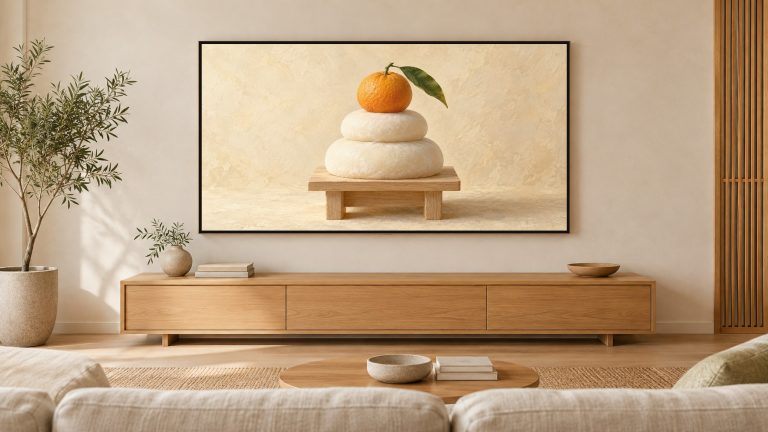 Kagami Mochi New Year Still Life | Frame TV ArtView on Etsy
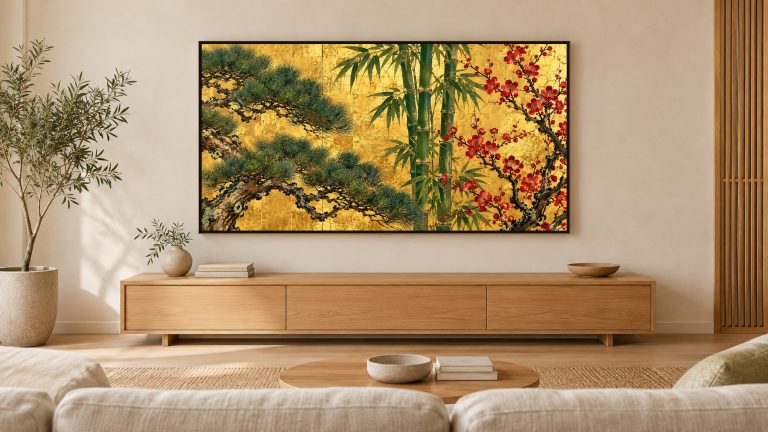 Pine, Bamboo and Plum on Gold | Frame TV ArtView on Etsy
Each piece is sold on Etsy as an instant download.
Sources
All sources checked on October 20, 2026 (JST). University, university encyclopedia, municipal and national museum sources only. Japanese-language passages are paraphrased in English.
- Iwate University, “New Year Decorations in Japan”. University international-exchange article: shared purpose, materials, placement and modern late-December decorating dates. Checked October 20, 2026.
- Okegawa City, municipal material on local customs and New Year observances. PDF pages 3–4 of 5, sections 門松・しめ飾り・鏡餅: pine and later bamboo, purification and simplified ropes, January 11 and opening the rice cakes. Checked October 20, 2026.
- Kokugakuin University, Encyclopedia of Shinto, “Shimenawa”. Academic encyclopedia entry on straw ropes, sacred or pure boundaries, and paper streamers. Checked October 20, 2026.
- Wakasa Town, Koho Wakasa, January 2013, page 19. First PDF page: traditional mirror/spirit interpretation of round rice cakes and welcoming the New Year deity. Checked October 20, 2026.
- Kyoto National Museum, “Three Friends of Winter: Pine, Bamboo, and Plum in the Arts”. New Year use of the plant grouping and its Chinese literati/Japanese Zen painting history. Checked October 20, 2026.
